
Introducing Speech to Form, the fastest way to collect field data. Read out your meter readings, walk through a soil log, narrate site conditions. QNOPY listens, understands, and fills in your form automatically.
Field data collection has always meant one hand on a clipboard and one eye on the ground. We think your hands should be free to do the actual work.
Field professionals spend an enormous amount of time doing something computers should handle: transcription. You observe something, write it down, then type it up later. Every step is a chance for error and a drain on time that should go toward analysis and judgment.
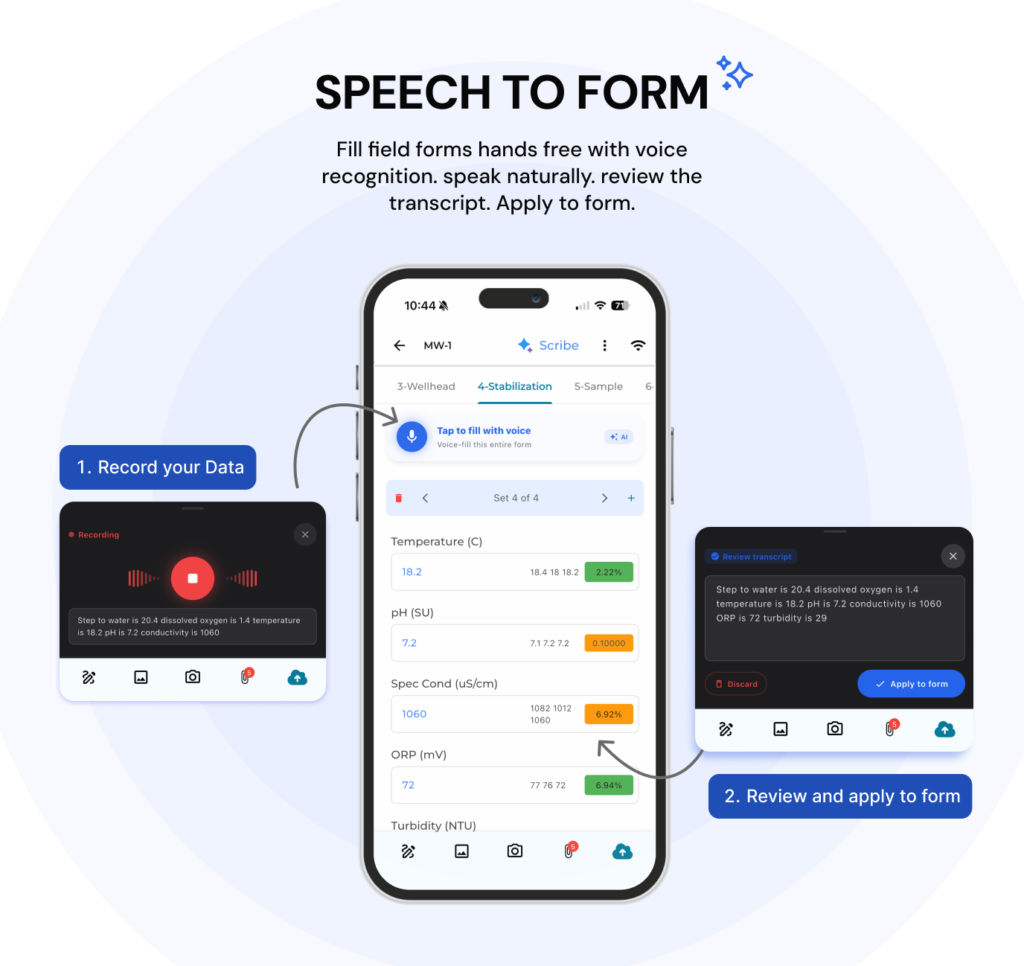
Speech to Form changes that entirely. Open the QNOPY app, tap the microphone, and speak naturally. Read your meter values out loud. Walk through your soil boring observations as you make them. Call out field conditions in real time. QNOPY’s AI listens, parses your words, and maps every value to the right field in your form automatically.
How it works
Record your observations
Tap the microphone and speak naturally. Read out meter values, describe soil conditions, note stabilization parameters exactly as you’d say them to a colleague. No special format required.
Review the transcript
QNOPY surfaces a clean transcript of everything you said. Scan it quickly to confirm your observations are captured correctly before committing anything to the form.
Apply to form and its done
One tap. Every value is placed into the correct field across your entire form. Temperature, pH, conductivity, ORP, turbidity: Speech to Form knows where everything goes.
The feature works across all your existing QNOPY forms without any reconfiguration. If you’re already using QNOPY for groundwater sampling, soil borings, or site inspections, Speech to Form is available today, just look for the Scribe button at the top of any form.
Built for real field conditions
We didn’t build Speech to Form in a quiet office. We built it for the realities of environmental and civil field work: gloves on, ambient noise, one hand holding a bailer, the other a probe. The app works offline and syncs the moment you’re back in range so even in low-signal areas, your recordings are safe and your data is captured.
The AI is trained on field vocabulary — it understands the difference between “specific conductance” and “standard conditions,” knows that “CL” means clay loam, and handles decimal readings, ranges, and unit abbreviations without missing a beat.
Field work demands focus. The best technology gets out of the way and lets you do your job. That’s exactly what Speech to Form is designed to do – disappear into your workflow so the data just gets done.